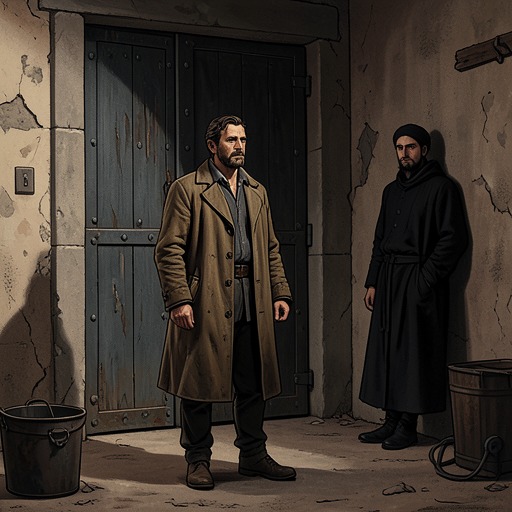
Pedro Páramo and Fulgor Sedano: Patron and Agent
Pedro PáramoPedro Páramo and Fulgor Sedano’s relationship is the working machinery of Pedro’s rule at Media Luna: Fulgor supplies the administrative skill and local knowledge through which Pedro converts debts, legal language, and intimidation into control of land. Their association begins with an imbalance of age and status, but quickly becomes a practical partnership in which Fulgor executes orders whose consequences reach well beyond the estate. His death at the hands of revolutionary fighters exposes the danger borne by the agent who carries Pedro’s power into the surrounding countryside.
Identity and First Encounters
Fulgor Sedano is a fifty-four-year-old unmarried professional estate manager, as he identifies himself in the formal declaration he makes against Toribio Aldrete. The document presents him as authorized to bring and conduct legal proceedings, by proxy and in his own name. That authority is not merely ceremonial: Pedro relies on Fulgor to manage Media Luna’s affairs, handle disputes, and act as his representative in dealings with other landowners.
Their personal history is sparse but pointed. Fulgor had seen Pedro once before without being seen by him, when Pedro was still a newborn. When they meet again, Pedro addresses him as though they were already close, although Fulgor has never dealt with him as an adult. Fulgor bristles at the familiarity. Even Don Lucas Páramo had not spoken to him in that manner, and Fulgor resents being treated like a farm servant by a young man who has never worked at Media Luna and knows its operations only by hearsay. The scene establishes an initial disparity: Pedro assumes command before Fulgor has accepted his authority.
That resistance does not last. Pedro asks about the estate’s condition, and Fulgor reports that business is bad and the last cattle have been sold. When Pedro proposes that Fulgor call him “don,” Fulgor complies, but the exchange remains tense. By the end of their conversation, however, Fulgor says that dealing with Pedro is beginning to please him. Their working alliance takes shape not through a declaration of trust but through the rapid appearance of tasks that make Fulgor indispensable.
Fulgor as Pedro’s Agent
Pedro puts Fulgor’s managerial and legal position to work almost immediately. He orders him to begin settling accounts, first with the Preciado women, to whom the estate owes a great deal and has repaid very little. Fulgor explains that Matilde has gone to live in a city, perhaps Guadalajara or Colima, while Dolores Preciado remains in possession of the Enmedio property. Pedro’s response is not to repay the debt in the ordinary way: he instructs Fulgor to ask Dolores to marry him, telling him to say that Pedro is deeply in love and that the decision rests with her. He also directs Fulgor to ask Father Rentería to arrange the matter. The marriage proposal thus enters the conversation as part of the settlement of an estate’s obligations and Pedro’s pursuit of the land attached to them.
Fulgor is not simply a messenger. Pedro expects him to translate objectives into workable actions, and Fulgor answers with questions about feasibility and available funds. His age, initially a point of resentment, becomes part of the contrast between the experienced manager and the young patron whose ambitions are larger than his knowledge of the estate. Pedro’s directives make clear that the relationship is not an equal partnership: Fulgor supplies competence, while Pedro determines what that competence is to accomplish.
The distinction becomes sharper in the dispute with Aldrete. Aldrete is fencing land and asks for the missing stretch of boundary fence to be installed. Fulgor describes the issue as a boundary matter and says Aldrete has measured correctly. Pedro dismisses the measurement, orders Fulgor to tell Aldrete to put the fences back where they were, and says that the fences should be demolished if necessary. When Fulgor asks about the law, Pedro rejects the question by asserting that they will make the law themselves. He then tells Fulgor to send men to visit Aldrete and file a complaint accusing him of usufruct, or of whatever charge comes to mind. The supposed legal process is paired with a threat of force; Fulgor is tasked with making both parts of Pedro’s order real.
Legal Maneuvering and Land Control
Fulgor’s declaration against Aldrete gives the conflict a formal appearance. He identifies himself by age and profession, asserts his authority to bring proceedings, and ends by asking that his accusation of usufruct be accepted. Yet Aldrete understands the weakness of the charge. After drinking with Fulgor to mark the drawing up of the document, Aldrete ridicules the paper as useless and mocks Pedro’s ignorance of the term. He also tells Fulgor that he recognizes Fulgor’s own capabilities, distinguishing them from the power of the patron behind him. The exchange shows that Fulgor can prepare the instrument Pedro demands, but cannot make its legal language persuasive to the person it targets.
Aldrete’s contempt does not undo Pedro’s order. His challenge is followed by the recollection of his last words while still in possession of his senses; afterward, he is heard crying out and behaving fearfully. The narrative links the paper to the coercive encounter around it: Fulgor has been made to file a charge, while Pedro’s authority supplies the pressure that makes the charge dangerous despite its apparent weakness. Legal procedure functions less as a neutral means of settling a boundary than as a tool for contesting Aldrete’s claim and asserting that Media Luna has no internal divisions or enclaves.
The work also shows how Pedro’s authority is exercised through waiting and access. On returning to Pedro’s house, Fulgor knocks with the handle of his whip and waits for Pedro to decide when the door will be opened. He notices the black ribbon knots hanging from the lintel, recalling that one had been added since his earlier visit. The repeated gesture and changed ribbons mark a household whose rhythms are controlled by Pedro, while Fulgor remains outside until admitted. Within that order, the agent who can direct legal complaints and estate business is still subject to his patron’s timing.
Death and the Limits of the Partnership
The partnership ends during an inspection connected to the estate’s water supply. Fulgor and an unnamed companion go toward the sluices to find out why the water level is falling. A group of men meets them, recognizes Fulgor as Media Luna’s manager, and identifies themselves as revolutionaries who have come for Pedro’s lands. They order Fulgor to release his animal and run to tell his patron that they will meet him there. Fulgor flees, but the men kill him while he is running; he dies with one leg raised and the other on the ground.
His companion stays still until nightfall, then brings the news to Pedro. Pedro does not respond by grieving over Fulgor or recounting their years of service. He orders the messenger to hurry, find Damasio, and tell the revolutionaries that they can come and address him directly. The contrast is stark: Fulgor has been killed while carrying a warning from the armed men to the estate’s master, and Pedro immediately turns to the next available agent. Fulgor’s death demonstrates both the reach and the cost of his role. He was the manager through whom Pedro’s authority operated beyond the household, but that position also made him a visible representative—and a target—of the landholding power the revolutionaries came to confront.